
<p>Follow the footsteps of emirs and traders through ancient cities that defined the world's most legendary trade route.</p>
Uzbekistan holds the greatest concentration of Silk Road splendor in Central Asia — the turquoise-tiled madrasas of Samarkand's Registan Square, the labyrinthine old city of Bukhara, and the walled desert citadel of Khiva. These cities once formed the crossroads where merchants, scholars, and empires from China to the Mediterranean converged.
Today, restored monuments, bustling bazaars, and a modern high-speed rail network make exploring this Silk Road heritage more accessible than ever.
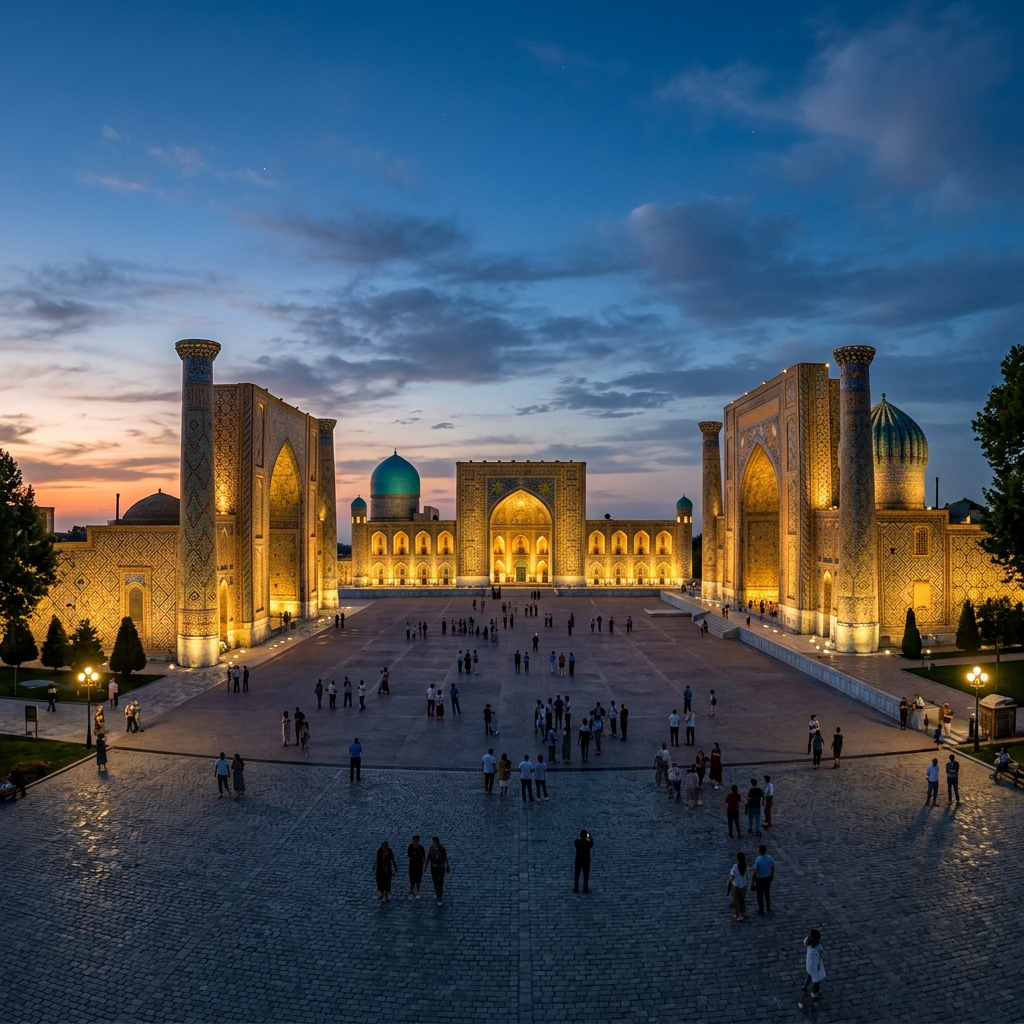
Three monumental turquoise-tiled madrasas forming one of the most spectacular public squares in the Islamic world.
A remarkably preserved medieval city of minarets, madrasas, and covered bazaars.
A walled inner city and open-air museum, one of the best-preserved examples of Central Asian architecture.
Expert local guides specializing in the history and architecture of the Silk Road cities.
Boutique stays in restored madrasas and traditional courtyard houses.
Comfortable travel via Uzbekistan's high-speed Afrosiyob trains and private vehicles.
Visits to traditional ceramic, silk, and paper-making workshops.
The Classic Silk Road Duo
Tashkent, Samarkand, Bukhara & Khiva
Beyond the Classic Route
Cover shoulders and knees when visiting mosques and madrasas.
While cards are increasingly accepted, cash is essential for bazaars and smaller vendors.
The Afrosiyob train between Tashkent, Samarkand, and Bukhara is fast, comfortable, and scenic.
March to May and September to November offer the most comfortable temperatures for exploring the Silk Road cities, avoiding the intense summer heat and cold winters of the continental climate.
Tashkent International Airport (TAS) is Uzbekistan's main gateway, with growing connections from Europe, Asia, and the Middle East.
The high-speed Afrosiyob train connects Tashkent, Samarkand, and Bukhara comfortably in a few hours each; private vehicles handle transfers to Khiva and other regional sites.
Uzbekistan offers visa-free entry or e-Visa access to citizens of many countries. Requirements vary by nationality and can change, so please confirm current entry policy via Uzbekistan's official e-Visa portal before booking travel.
The local currency is the Uzbek Som (UZS). Cards are increasingly accepted in cities and hotels, but cash remains useful at bazaars and smaller establishments.
Uzbekistan's national dish — rice cooked with meat, carrots, and onions in a single pot.
Grilled skewered meat, a staple of Uzbek bazaars and restaurants.
Baked pastries filled with spiced meat or pumpkin, similar to a samosa.
Traditional round bread baked in a tandoor oven, central to every Uzbek meal.
Uzbekistan's two greatest Silk Road cities, connected by high-speed train.
View ItineraryTashkent, Samarkand, Bukhara, and the desert citadel of Khiva on the full Silk Road circuit.
View ItineraryYes, Uzbekistan is considered one of the safer destinations in Central Asia, with a strong and growing tourism infrastructure.
Uzbek is the official language and Russian is widely spoken; English is understood in tourist areas of major cities.
A 6-day trip covers Samarkand and Bukhara; 10-12 days allows time to also add Tashkent and Khiva.
Fill out the details below and our travel specialists will create your dream itinerary.